Rent vs Buy in San Jose: 2026 Data Breakdown
San Jose remains one of the most expensive housing markets in the country. This 2026 rent-vs-buy breakdown compares median home prices, average rents, mortgage rates, monthly ownership costs, equity growth, and the lifestyle factors that can change the decision.
San Jose is one of the clearest examples of why a simple monthly payment comparison is not enough. In many parts of the United States, buying can sometimes compete with renting after accounting for equity growth, rent inflation, and long-term appreciation. In San Jose, the gap between rents and purchase prices is so large that the math often starts with a very difficult question:
Are you buying because it is cheaper, or because you want long-term stability, ownership, and exposure to Silicon Valley home appreciation?
Based on early 2026 data, renting in San Jose is usually much cheaper on a monthly cash-flow basis. Buying may still make sense for some households, but the case usually depends on a long time horizon, high income stability, a large down payment, confidence in the local market, and a personal preference for putting down roots.
Key Takeaways
- San Jose buying costs are extremely high. Redfin reported a March 2026 median sale price of about $1.489 million for San Jose homes.
- Renting is usually much cheaper month-to-month. Zillow reported an average San Jose rent of $3,120 as of May 21, 2026, with the average two-bedroom at $3,174 and the average three-bedroom at $4,295.
- The mortgage payment is only one part of ownership cost. Property taxes, insurance, maintenance, HOA dues, repairs, and transaction costs can materially change the result.
- Buying can still build wealth if the home appreciates enough. The question is whether the equity growth and appreciation can beat the cheaper rent path plus investing the cash difference.
- The best answer depends heavily on your timeline. A short stay usually favors renting. A long stay may favor buying if you can afford the payment and the market performs well.
San Jose 2026 Market Snapshot
To make the comparison concrete, this article uses a May 2026 snapshot from public market sources and a simplified rent-vs-buy model. These numbers are not a prediction. They are a starting point for understanding how difficult the San Jose decision can be.
| Metric | 2026 Snapshot | Why It Matters |
|---|---|---|
| Median San Jose sale price | $1,489,000 in March 2026 | This is the purchase-price anchor for the sample buying scenario. |
| Median days on market | 10 days in March 2026 | Fast sales suggest buyers still face competition for desirable homes. |
| Sale-to-list price | 104.5% in March 2026 | Homes were, on average, selling above list price. |
| Average San Jose rent | $3,120 as of May 21, 2026 | This is the broad average across all bedroom counts and property types. |
| Average two-bedroom rent | $3,174 per month | Useful for smaller households comparing condos, townhomes, or apartments. |
| Average three-bedroom rent | $4,295 per month | More relevant for families comparing against a larger home purchase. |
| 30-year fixed mortgage rate | 6.51% as of May 21, 2026 | Mortgage rates strongly affect affordability in a high-price market. |
The key takeaway from the snapshot is simple: San Jose has both high rents and very high home prices, but home prices are so elevated that buying usually requires a much larger monthly commitment than renting.
A Sample San Jose Buying Scenario
Let’s model a buyer purchasing at the March 2026 median sale price of $1,489,000. This example assumes 20% down and a 30-year fixed mortgage at 6.51%. Actual mortgage pricing may differ based on credit score, loan type, points, lender, debt-to-income ratio, property type, and whether the loan falls within high-balance conforming limits or requires a jumbo product.
| Buying Assumption | Estimated Amount |
|---|---|
| Purchase price | $1,489,000 |
| 20% down payment | $297,800 |
| Estimated loan amount | $1,191,200 |
| Estimated monthly principal and interest | $7,537 |
| Estimated property tax at 1.2% annually | $1,489 per month |
| Estimated homeowner insurance | $250 per month |
| Estimated maintenance reserve at 1% annually | $1,241 per month |
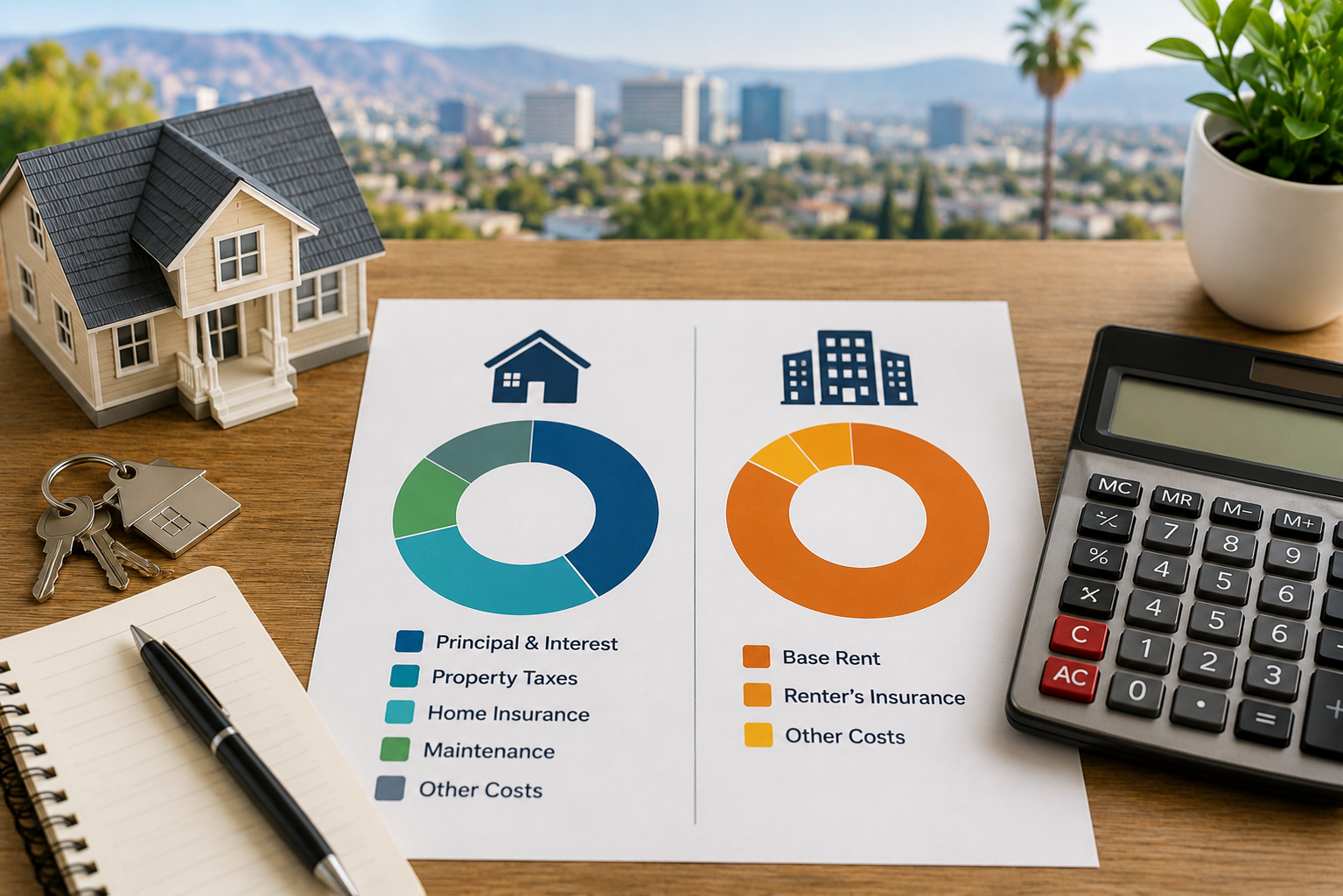
| Estimated monthly ownership cost before HOA and utilities | $10,517 |
This does not mean every San Jose buyer will pay exactly $10,517 per month. A buyer with a larger down payment, a lower rate, a smaller property, a condo with HOA dues, or a different insurance and maintenance profile could see a different result. But the example shows why the rent-vs-buy question is so difficult in San Jose: even before HOA dues and utilities, the monthly ownership estimate can be dramatically higher than rent.
Monthly Cost: Renting vs Buying
Using the simplified buying scenario above, the estimated monthly ownership cost before HOA and utilities is about $10,517. Zillow’s San Jose rent data shows an average rent of $3,120 across all beds and property types, $3,174 for a two-bedroom, and $4,295 for a three-bedroom.
| Comparison | Monthly Rent | Estimated Monthly Ownership Cost | Monthly Buying Premium |
|---|---|---|---|
| Average San Jose rental | $3,120 | $10,517 | $7,397 |
| Average two-bedroom rental | $3,174 | $10,517 | $7,343 |
| Average three-bedroom rental | $4,295 | $10,517 | $6,222 |
On monthly cash flow alone, renting is the clear winner in this sample scenario. A family renting a three-bedroom at the reported average could pay roughly $6,222 less per month than the estimated cost of buying at the median San Jose sale price.
But monthly cash flow is not the whole story. Part of a mortgage payment is principal, which builds equity. A renter does not build home equity, but a renter may be able to invest the down payment and the monthly cash-flow difference. That is where the real rent-vs-buy analysis begins.
The Equity Argument for Buying
Buying looks expensive because the monthly payment is high. But homeownership also creates two potential wealth drivers:
- Principal paydown: Part of each mortgage payment reduces the loan balance.
- Home appreciation: If the home rises in value, the owner benefits from the increase.
In the sample scenario above, the first year of mortgage payments would include roughly $13,300 of principal paydown and about $77,200 of interest. That means most of the early mortgage payment is interest, not equity. Over time, more of the payment goes toward principal, but the early years can be especially expensive if the buyer sells quickly.
This is why timeline matters so much. Buying for two or three years is very different from buying for 10 or 15 years. Short ownership periods expose the buyer to transaction costs, market timing risk, and the fact that early mortgage payments are heavily weighted toward interest.
The Opportunity Cost Argument for Renting
Renting can look “worse” emotionally because the monthly payment does not build home equity. But in San Jose, the rent path may free up a very large amount of cash.
In the sample purchase, a 20% down payment is $297,800. If a renter keeps that money invested instead of using it as a down payment, the investment return matters. At a 5% annual return, that down payment alone could grow by more than $82,000 over five years before taxes. If the renter also invests the monthly cash-flow difference, the rent path can become financially powerful.
This is the part many basic comparisons miss. The question is not simply:
“Is rent cheaper than the mortgage?”
The better question is:
“Will the home’s equity growth and appreciation beat the renter’s invested down payment and invested monthly savings?”
How Much Appreciation Would Buying Need?
In a high-cost market like San Jose, buying often needs meaningful appreciation to beat renting financially. In a simplified five-year model using the sample purchase price, a 20% down payment, 6% selling costs, a $4,295 three-bedroom rent comparison, and a 5% investment return for the renter’s unused cash, buying would need roughly high-single-digit annual appreciation to fully catch up with the rent-and-invest path.
That does not mean San Jose cannot deliver strong appreciation. Silicon Valley has historically benefited from high incomes, limited land, major employers, and strong demand for well-located homes. But it does mean a buyer should not assume that “buying is always better” without checking the actual numbers.
When Buying in San Jose May Make Sense
Even with the high monthly cost, buying can still make sense in San Jose for the right household. The decision may be more defensible if several of these are true:
- You plan to stay at least 7 to 10 years. A longer timeline gives appreciation and principal paydown more time to work.
- Your income is stable and high enough to handle the payment. The payment should not leave you house-poor or dependent on bonuses or stock grants that may fluctuate.
- You have a large down payment. More cash down can reduce the monthly payment and interest burden.
- You value school boundaries, commute stability, or lifestyle control. These are real benefits even when renting is cheaper.
- You are comfortable with local market risk. San Jose can be strong, but tech-sector volatility, rates, and affordability pressure still matter.
- You may convert the home into a rental later. This can improve flexibility, but only if the rental numbers work.
When Renting in San Jose May Be Smarter
Renting may be the better decision if your situation is uncertain or if the buying premium would limit your financial flexibility. In San Jose, renting may be especially attractive if:
- You may move within five years. Transaction costs can erase a lot of potential equity growth.
- You are still building your down payment. Buying too early can create cash stress.
- Your job, income, or visa situation is uncertain. Flexibility has value.
- You want to invest aggressively outside real estate. The monthly savings from renting can be redirected into diversified investments, a business, or emergency reserves.
- You would need to buy a home that does not fit your lifestyle. Stretching for a property you do not actually like can create both financial and emotional regret.
- You are relying on optimistic appreciation to make the math work. If the numbers only work in a best-case scenario, renting may be safer.
The San Jose Decision Is Not Just Financial
The rent-vs-buy decision is partly mathematical and partly personal. The math can tell you whether buying is likely to improve your net worth. It cannot fully measure how much you value stability, ownership, school continuity, a yard, the ability to remodel, or not worrying about a landlord selling the property.
At the same time, lifestyle benefits should not be used to ignore affordability. A home that technically builds equity can still be a bad decision if the payment creates constant stress, prevents saving, or forces you to depend on a perfect career path.
Want to Compare Your Own San Jose Numbers?
Use Home Decision Lab’s Rent vs Buy Calculator to compare rent, purchase price, mortgage rate, property taxes, maintenance, expected appreciation, rent growth, investment return, and your planned time in the home.
Questions to Ask Before Buying in San Jose
Before making a decision, run your own numbers and answer these questions:
- How long do I realistically expect to stay? Be honest. Five years and 12 years can produce very different outcomes.
- What is my true monthly ownership cost? Include mortgage, property tax, insurance, HOA, maintenance, utilities, and repairs.
- What would I do with the cash if I rented? The rent path only wins financially if the savings are saved or invested, not spent.
- How much appreciation am I assuming? Test conservative, moderate, and optimistic scenarios.
- Can I handle a job loss, stock compensation drop, or emergency repair? A high-cost home requires a strong safety cushion.
- Am I buying the right property or just trying to get into the market? In expensive markets, rushing can lead to compromising on location, layout, condition, or commute.
Frequently Asked Questions
Is it cheaper to rent or buy in San Jose in 2026?
Based on the sample numbers in this article, renting is much cheaper on a monthly cash-flow basis. Buying may still build wealth over time, but the home needs enough appreciation and principal paydown to overcome the higher monthly cost, transaction costs, and the renter’s ability to invest the cash difference.
What income do you need to buy a home in San Jose?
It depends on your down payment, debts, credit score, interest rate, and comfort level. A household buying near the median sale price may need a very high income to keep housing costs manageable. Many buyers also rely on large down payments, stock compensation, dual incomes, or family help.
Does buying in San Jose always build more wealth than renting?
No. Buying can build wealth if the home appreciates, the owner stays long enough, and the payment remains affordable. Renting can also build wealth if the renter invests the down payment and monthly savings. The better path depends on the numbers and the discipline to invest the difference.
Should I wait for San Jose home prices to drop?
Waiting can help if prices fall, rates improve, or your down payment grows. But waiting also has risks: prices may not fall, rents may rise, and the specific home you want may become more expensive. Instead of trying to perfectly time the market, compare scenarios using conservative assumptions.
What is the biggest mistake buyers make in San Jose?
One common mistake is focusing only on the mortgage payment and ignoring the full ownership cost. Property taxes, insurance, maintenance, HOA dues, repairs, and selling costs can change the result. Another mistake is assuming that appreciation will automatically make the purchase profitable.
Final Thoughts
In San Jose, renting often wins the short-term math because the cost of buying is so high relative to rent. But the final decision is not always simple. Buying may still make sense for households with strong income, a long timeline, a large down payment, and a desire for stability in one of the country’s most important technology markets.
The safest way to decide is not to rely on rules of thumb. Run the numbers with your actual rent, target purchase price, mortgage quote, down payment, expected time horizon, investment assumptions, and risk tolerance. Then compare the result against your lifestyle goals.
Want a personalized estimate? Use our Rent vs Buy Calculator to compare your San Jose renting and buying scenarios side by side.
Sources
Educational only. This is not financial, legal, tax, mortgage, investment, or real estate advice.